Current Projects
Siblings and AAC Project
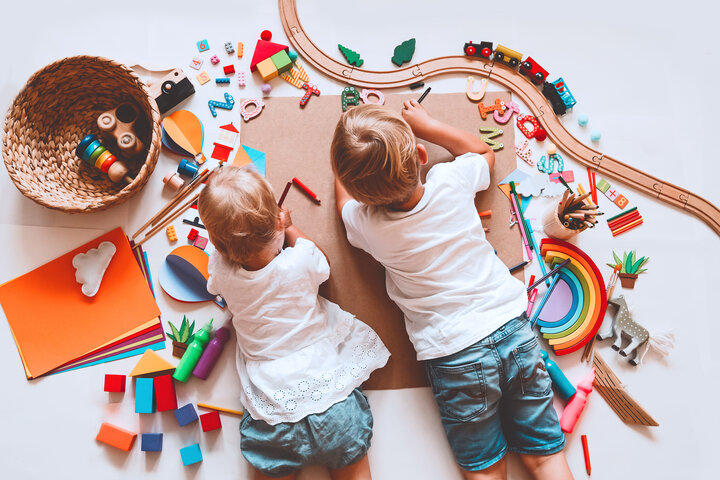
Dr. Ousley and Dr. HyeonJin Yoon are evaluating sibling relational dynamics, including roles, perceptions, and typical interactions, to better support autistic children who use AAC.1 The team is recruiting 10 Nebraska families, each with an autistic child between the ages of 6 and 12; a neurotypical sibling, age 5 to 15; and a parent or caregiver. This study will include interviews of both siblings and the parent and a recorded play interaction between the siblings. The goal of this study is to inform future sibling interventions to increase social communication for young autistic children who use AAC. If you are interested in participating (as a family or research assistant) please contact Dr. Ciara Ousley.
1 Click here to learn more about the project: New research explores communication among autistic children, siblings

Play and AAC Project
Dr. Ousley and Dr. Kevin Pitt are collaborating on a series of projects around the topics of play and AAC.1 These project vary from forums to surveys. Pitt and Ousley are currently conducting a survey of parents of young children with autism and/or cerebral palsy who use AAC to understand how children are communicating during play time. Results will help inform future trainings, supports, and AAC design. The team is currently analyzing and disseminating our findings from this survey!
1 Pitt, K. M., & Ousley, C. L. (2024). Reimagining AAC designs for children during dynamic social situations by leveraging smart device design. Augmentative and Alternative Communication, 1-7. https://doi.org/10.1080/07434618.2024.2434673
View the PDF

VSDs for Adolescents and Adults
Mallory Bellamy and Dr. Ousley are conducting a systematic review of the literature on using visual scene displays to support communication or participation for individuals with developmental disabilities 9 years of age or older. This review investigates participant characteristics, conditions, and the quality of the research according to CEC standards. Check back here for updates!
Partnering with Nebraska Families: Accessibility and Success of Early Intervention
The SCADD Lab and The Learning Lab (run by Dr. Susan Loveall) are evaluating the experiences of families in Nebraska who have a child that is currently receiving, or has previously received, Early Intervention services in the state of Nebraska. The goal of our joint-lab project is to understand how Early Intervention can become more accessible and successful for families in Nebraska and across the nation. We are very grateful for funding support from Calvin's Legacy Foundation! If you are interested in participating (as a family or research assistant) please contact Dr. Ciara Ousley or Dr. Susan Loveall. This study is currently being conducted. Check back here for updates!

Math Storybooks in VSD Apps
Tess Szydlik and Dr. Ousley are investigating the effects of shared story reading using math storybooks embedded in visual scene display apps on early math skills. The team is currently recruiting children ages 2-7 with developmental disabilities and communication needs in the Lincoln area. If you are interested in participating, please contact scaddlab@unl.edu.

Literature Review on Family-Implemented NDBIs
Naturalistic Developmental Behavioral Interventions (NDBIs) are empirically-supported interventions that blend the sciences of developmental psychology with applied behavior analysis. Most NDBIs capitalize on training and coaching families of young children to support the social, communication, and play skills of the child. Dr. Ousley is working with Dr. Veronica Kang out of University of Maryland to evaluate all family-implemented NDBI research to understand the demographic information of family members who have implemented these interventions in the research literature. We are currently analyzing the data and will disseminating findings soon. Check back for updates in the near future!
View preliminary findings here!